Can you have a story that mentions Norse Mythology without Thor? Nope. Not only is he the God of Thunder, he’s the one who gives Jarnsaxa an axe to grind. Derek Meyer lends his voice to the Scandinavian hero who’s worshipped everywhere from ancient farming rituals to kids’ lunch boxes today.
Thor is generally seen as a warrior god. However, his marriage with Sif (goddess of fertility) let his role widen, to one who brings rain for fruitful harvests. When Christian influence came to Scandinavia, emblems of his hammer, Mjölnir, were worn by those loyal to pagan faith. In time, the hammer symbol became blended with the Christian cross, to show a compromise between the faiths. Despite its name’s original meaning, “that which pulverizes to dust,” the symbol became a mark of protection in place markers and amulets.
Thunor the Thunderer, carved on the runestone Sö 86, about the year 1000.
Thor’s relationship with Jarnsaxa has been described as lover and sometimes a spouse, but the relationship is not completely amicable. Though legend claims she fed and protected Thor against the frost giants, the sons he sired with her are not as hospitable. One, Magni, embodies boundless strength, the other, Modi, homicidal fury. Legend predicts that when Ragnarok comes, and Thor loses his hammer, it will be laid at their feet. He must have really done something to make her very, very angry.
Fortunately, Derek is not a bad guy. He’s also remarkably concise.
Derek has been living and acting in the Twin Cities since 2007, and works at The National Theatre for Children. He likes riding his bike around the city, and even the suburbs at times. He also enjoys dancing and is hoping that is featured in this project.
What made you decide you wanted to do this project?
I actually heard this play being read years ago and thought it was interesting, so I am looking forward to seeing where it goes.
Who’s your favorite character in Norse Mythology?
My favorite character in Norse Mythology is Hel…because she scares the crap out of me.
What are you reading these days?
I just picked up “The Windup Girl” by Paolo Bacigalupi.
What’s your favorite pre-performance ritual?
Depending on the show I like to either work out or take a nap.
What’s under your bed right now?
I actually had to check on this one and the honest answer is one small empty cardboard box…I have no idea what it held at one time.
You know that Jarnsaxa Rising is shaping up to be a really cool podcast. Just how cool? Our cast includes a man who is cool enough to portray Fonzie. Let that sink in for a minute.
John T. Zeiler will be disguising his motorcycle macho flair, however, when he plays Dr. Eric Aspinall. Though he and Fonzie both have the skills to fix 1950s-era juke boxes, the similarities end there. Dr. Aspinall makes up half of the team assigned to investigate the “possible threat to profitability” at the abandoned wind farm. He’s an electrical engineer, but Jarnsaxa assumes that his title means he can fix the hole in her soul.
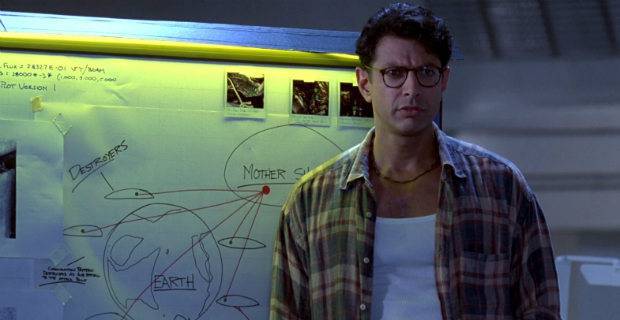
The Tech Guy Archetype runs like Ariadne’s thread throughout science fiction and fantasy stories. This character can fix anything, and seems to be socially challenged, but often shows unique talent for empathy and honesty. Star Trek’s Geordi LaForge, Independence Day’s Dr. Levinson, and Stan in Eternal Sunshine of the Spotless Mind initially take a back seat to other characters. In a crisis, it’s their emotional intelligence that breaks an impasse.
“You just can’t rely on the plain and simple facts. Sometimes they lie.” -Geordi LaForge
John T. Zeiler is ridiculously excited to be joining this dynamite cast for adventure and magic. Graduating from Gustavus Adolphus, with majors in dance and English, John has been entertaining the masses for the last eight years. Now, he has big kid job and gorgeous loving family and still finds time to make believe and dive into a character. Love you Lacey and Lila. Recent credits include Arthur Fonzarelli in Minneapolis Musical Theatre’s Happy Days a New Musical; Engineer in Theatre Pro Rata’s Elephant’s Graveyard; and Jeffrey Ford/Boston Corbett in Mainly Me’s 2014 MN Fringe Festival Production Our American Assassin or You Can’t Handle the Booth!.
1) What made you decide you wanted to do this project?
– The subject matter initially sucked me in. Growing up, Greek and Norse Myths were as much a part of my life as were The Ninja Turtles and He-Man. As I got older all mythologies continued to fascinate me. An engaging subject, fantastic script, and superb group of talent was the perfect combination and I couldn’t say no :-).
2) Who’s your favorite character from Norse Mythology?
– When I was a kid, it was Odin. To my nine year old self, the all powerful and destructive were the most appealing. I was also a big fan of Thanos and Galactus from the Marvel Universe, to put it in perspective (I promise I was not a troubled child). In college, I really started following the wives/women of these worlds. Frigg became my new favorite. There is something so incredibly awesome and attractive about a Goddess that not only shares the same strengths as her brothers, but also does a damn good job of keeping their husbands in check (well, as much as they can). These days, after working at Summit Brewery for a stint of time, I have a special place in my heart for Saga. When your resume sports “Drinking companion to Odin” and “Seer of the past” you better believe I’ll fall in love with you. So, watch out all of you history majors that party with old, crazy, and powerful men.
“Checkmate.” -Dr. David Levinson
3) What are you reading these days?
– It won’t surprise anyone reading this that I’m currently working my way through four different comic book anthologies (listed below).
Weapon Brown Written and Illustrated by Jason Yungbluth – I found this gem on Kickstarter. Jason took every beloved character from the funny pages and threw them into a post-apocolyptic world. It’s 400 pages of fantastic nerdy chow. Not only can this guy draw but he tells a pretty good story.
Batwoman Vol. 1 Hydrology (the new 52) by J.H. Williams III and W.Haden Blackman – Originally, I purchased this as a gift for my wife and of course I too had to read it. It’s graphic, it’s emotional, it’s getting female heroes out of the ridiculous boob hugging latex body suits and into real stories and real lives.
Death of Wolverine by Charles Soule and Steve McNiven – This was a quick read and a guilty pleasure. Wolverine is one of my favorites (who cares if he’s mainstream, I’m playing the hipster card and telling you I loved him before everybody else did) and of course I had to see how they wrap up his story. I keep going back to study the art and make sure I didn’t miss anything.
And, last but not least…
Thor, the Goddess of Thunder by Jason Aaron, Russell Dauterman, and Jorge Molina – This was another present for my wife that needed to be in my hands, taken in through my eyes, and placed in my brain. After some key events, Mjolnir no longer finds Donald Blake/Thor worthy to wield her might. A mysterious woman now wields the hammer and is bringing some delicious pain to those that threaten Asgard.
“You looked happy. Happy, with a secret.” -Stan
4) What’s your favorite pre-performance ritual?
– Mainly Me Theatre Company introduced me to a pre-show ritual that I would love to bring to all of my projects. We stand in a circle and sing the theme song to Fresh Prince of Bel-Air as loud as humanly possible.
Shannon will be playing Balder, the Norse god of peace. Unlike his previous, ebullient incarnation in a Lindsay Harris-Friel play, this archetype is much closer to Shannon’s natural personality. Balder embodies all the goodness of light and purity. It was foretold that his death would presage Ragnarok, the Norse apocalypse. As a result, his mother convinced all life forms in the Nine Worlds not to harm Balder, and she succeeded, with one exception. But, that’s another story. Considering that Balder is a god of purity, light and peace, but not justice, this makes Balder a very interesting character, beneath his brightly polished surface.
Who’s a pretty boy?
Shannon Troy Jones is very excited to working with Lindsay Harris-Friel and Theatre Pro Rata on Jarnsaxa Rising. He previously had the pleasure of performing in Lindsay’s stage play, Traveling Light for Theare Pro Rata. He’s been working as an actor, writer, and artist in the Twin Cities since 2003. Some of his favorite shows have included Mrs. Charles (Freshwater Theatre), The Birth of Venus (20% Theatre), Women’s History Month: The Historical Comedybration (with Fablulous Prizes) (Black Market Doctor), and The Good Woman of Setzuan, 44 Plays for 44 Presidents, The Spanish Tragedy, and of course Traveling Light (Theatre Pro Rata).
What made you decide that you wanted to do this project?
I have been lucky enough to work with both Lindsay and Theatre Pro Rata before. And the script is bonkers!
Who is your favorite character from Norse Mythology?
My knowledge of Norse mythology is based almost entirely on Neil Gaiman’s American Gods and Marvel Comics. I was going to say Hrimhari, whom I just learned is an Asgardian character that was invented by Marvel, so I fail. So I’m going to say Hela (or Hel), daughter of Loki and ruler of the realm of Niflheim, because she looks badass in the comic books and has been involved in some of my favorite stories!
What are you reading these days?
Scripts, scripts, scripts! Buffy the Vampire Slayer Season 8 comic books. I have also been trying to read Thomas Pynchon’s Gravity’s Rainbow for the past year. Someday I will actually commit to tackling that beast!
What’s your favorite pre-performance ritual?
I don’t have any consistent rituals that I follow, but I really like Crazy Eights for getting energized.
What’s under your bed right now?
Wrapping paper, that one sock I can never find, and the monster that took it.
Witch trials happened throughout the Western world in the 15th, 16th and 17th centuries (and, some would argue, still happen today). We know a lot about persecution of women as “witches” in England and early America, but we know less about it in other countries. Jarnsaxa has shown up in various guises at different times, and met religious, corporate and personal conflict.
Leslie will be playing Widow Gregersen, an practitioner of a lot of different ideas pervasive in Old Norse and modern-day culture. Though Christianity was not unwelcome in Scandinavia, pagan ideas and processes stayed put when push came to shove. Women were often the first responders in medical situations, and they could use runes and songs along with hot water and herbs for care. Widow Gregersen knows old ways to combat the dragur, or what Christians might perceive as a witch, though she’ll stay on the good side of the Church to keep business going. However, her ability to use old magic may make her more sensitive to it.
Everybody loves a nice picnic.
Leslie is an actor, singer, and goofball originally from Washington. D.C. Representative Theatre: Park Square: The Diary of Anne Frank; Theatre in the Round: Godspell; Chameleon Theatre Circle: Blood Brothers; Black Market Doctor: Women’s History Month: The Historical Comedybration (with fabulous prizes); The National Theatre for Children: The Energized Guyz and the Conservation Caper. In her spare time, she plays the ukulele, drinks too much coffee, and binge-watches LOST.
What made you decide that you wanted to do this project?
Podcasts and science fiction are two of my favorite things!
Who’s your favorite character from Norse Mythology?
Odin. But I’m not as well-versed in Norse Mythology as I should be, and I’m betting there’s someone else out there for me.
What are you reading these days?
I just finished “Bad Feminist” by Roxanne Gay, and I’m thinking about picking up either Cheryl Strayed’s “Wild” or Steven King’s “11/22/63”
What’s your favorite pre-performance ritual?
Dancing around to Beyonce’s “7/11”
What’s under your bed right now?
All of my shoes. And probably a bunch of bobby pins.
Our story takes place over multiple times and places at once, so not all of our characters are Norse deities and monsters. Sometimes the most frightening creatures come from Scottsdale.
Molly Pach will be playing Mrs. Kristy Wallace, Head of Brand Management for The Corporation. She’s in charge of finding and/or predicting all threats to the Corporation’s profitability, and ensuring those threats are eliminated, with the highest degree of security and plausible deniability. This ice queen is hardly invulnerable; sometimes the best attackers have their own dirty little secrets.
President and CEO of Yahoo, Marissa Mayer (Reuters/Jackson)
Molly hails from Milwaukee, WI and has made the Twin Cities her home for the past 3 years. She enjoys ice cream runs to DQ with her husband, snuggles from her black lab, Birdie, and lounging in bed with period British dramas. She is a member of the Minneapolis Catholic Worker Community where she displays her kick ass organizational skills taking minutes and facilitating at monthly meetings, and setting new records for dish washing at their weekly community meals. Her most recent interest is finding the perfect recipe for fried chicken.
What made you decide that you wanted to do this project?
Carin Bratlie. I will never say no working on a project she is involved in. I find her to be a powerful inspiration for all things life related and one of the best directors I have ever worked with.
Amy Bouzaglo, the culinary and business mastermind behind Amy’s Baking Company of Scottsdale, Arizona. (Reddit)
Who’s your favorite character from Norse Mythology?
THE KRAKEN!!!! I have an intense fear for all things that live in the sea. A giant octopus that lives at the bottom and emerges only to bring you to your watery death?! Yeah, that works for me!
What are you reading these days?
A collection of stories by Colette.
What’s your favorite pre-performance ritual?
Listening to Ke$ha while I put on my makeup. I do it with headphones so no one judges me and the fact that I am listening to Ke$ha.
What’s under your bed right now?
Floorboards. The hubby and I got rid of our last bed frame because it squeaked too much. We sleep on a mattress and box spring.
Ethan’s going to be playing Loki, a character so popular in Western folklore and culture that he needs little to no introduction. Scholars haven’t clarified exactly the relationship between the Aesir and this shape-shifting Jotun trickster deity, but the gods need him as much as they are infuriated by him. His ability to change gender, species, and size makes him able to solve as many problems as he causes. Though he’s known as the father of lies, he’s one of world culture’s favorite villains.
Ethan Bjelland, originally of Decorah, IA, is a freelance theatre artist and teacher and translator of Norwegian, Swedish, and Danish. Ethan has previously worked with Theatre Pro Rata as the Preacher in Elephant’s Graveyard in 2014. Other stage credits include The Drawer Boy, The Philadelphia Story (Commonweal); The Foreigner, Crazy for You!, This Untoward Generation!, Ichabod Crane… (St. Croix Festival); CRAZYFACE (Shadow Horse); If We Were Birds (Theatre 20%); Ghost Sonata, and From Darkness (nimbus).
What made you decide that you wanted to do this project?
Well first, I was excited to work with Theatre Pro Rata again, as they were the first company I had the pleasure of acting with when I moved to the Twin Cities. So many incredible people, and some of my best friends so far in this area are so connected with TPR, that I couldn’t say no.
Second, and probably the biggest kicker–I am a huge Scandinavian Studies nerd, and I am fascinated by Åland, where the drama takes place, and hope to visit sometime
Who’s your favorite character from Norse Mythology?
As confessed, I have a dark, geeky passion for all things Nordic. When I was little, while the other kids were at Bible Camp and Band Camp, I went to Norwegian Immersion Camp. After 10 years, I still go back and work every now and then. Sometimes, all of the counselors dress up as Norse gods and goddesses and we have an entire day (sometimes three) in character. I’ve been known to play a pretty mean Loki. There’s something special about being able to troll kids in a foreign language whilst suited in motley that isn’t quite the same outside of Norwegian camp.
What are you reading these days?
I just picked up Aksel Sandemose’s classic novel and social criticism, A Fugitive Crosses His Tracks.
What’s your favorite pre-performance ritual?
Yoga/Pilates. Just a few sun-salutations and centering. There’s also a voice and enunciation bit that I like to run when I have a dialect or some tricky lines, called the Announcer’s Test.
What’s under your bed right now?
I haven’t looked in a while. It might be fun to check out soon, if not for the “Oh, that’s where that went!” -factor.
Just who are these people that are lending their voices to audio drama? We think these actors are too good to hide, so we’ll be sharing them with you one at a time (don’t want to overload you too fast, darlings).
Amy Pirkl will play Sif, the Norse goddess of fertility. Sif is associated with summertime and abundance; as Thor’s wife, she provides his thunderous aspect with a fruitful outlet. The Poetic Edda is full of salacious rumors about Sif and her feelings about Loki, but she claims to be above reproach:
Welcome now, Loki, and take the crystal cup
full of ancient mead,
you should admit, that of the children of the Aesir,
that I alone am blameless.
She’s such a sweetheart. It’s really a shame that she stole Jarnsaxa’s man.
Amy Pirkl is a Company Member of Theatre Pro Rata. She is a freelance props designer, and has worked at the Guthrie, Park Square, Theatre in the Round, Nimbus, Yellow Tree, and a butt ton of others. Amy also is a member of Brain Punch Games, and a puzzle constructor/operator at Trapped Puzzle Rooms. She loves cats more than is reasonable, and her dog Badger is the best thing to ever happen on this planet. When Amy grows up, she wants to be a firefighter or Godzilla.
Amy is partly excited to be involved in this project because she wants her husband to think she’s a cool kid. He is a sound guy and a Norse Mythology buff.
Amy’s favorite character from Norse Mythology is Ratatoskr because she likes squirrels.
Amy is currently reading A Clash of Kings by George R. R. Martin. Other books on her nightstand include: Hitchhiker’s Guide to the Galaxy, the Tao Te Ching, the Tarot Bible, and Dr. Seuss’s Sleep Book.
Amy’s favorite pre-performance ritual is drinking a goblet of mead, then smashing it so no other mortal can drink from it again.
At this very moment there is a kitten named Gir lurking under Amy’s bed, waiting for her chance to attack the other cat, Kittenvader Zim.
Jarnsaxa is one of the lesser-known characters in Norse mythology, but her mystery is only one of the things that makes her the most interesting. When Carin game me the original writing prompt, I started researching the spot she described.
North of the 60th parallel in the Baltic is The Aland Islands. During the summer, they’re a popular destination for tourists seeking rustic peace. Mostly, they’re known for iron mining (abandoned in the 1800s), beets, and cows. In ruminating on the most concrete elements (wind, waves, iron) and doing some meditative web-surfing, I found Jarnsaxa. She’s a creature who comes up in important ways in Norse mythology, but much is left out. Jarnsaxa makes ripe material for contemporary imagination.
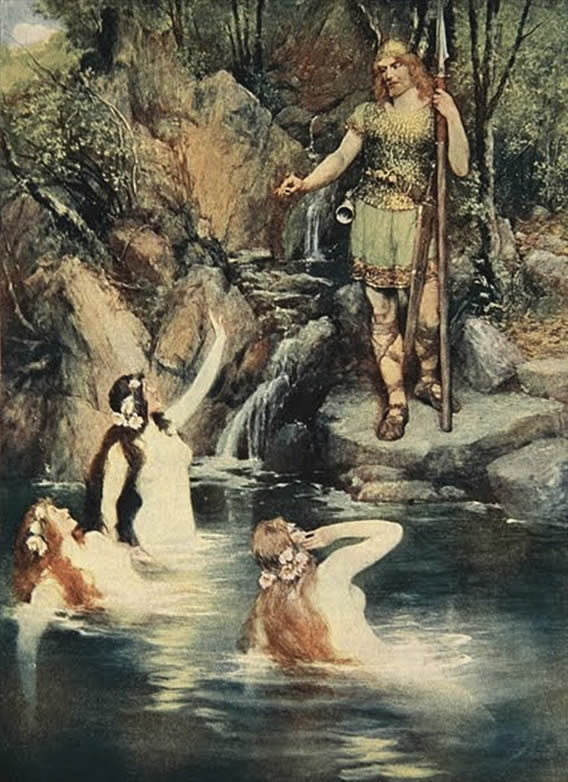
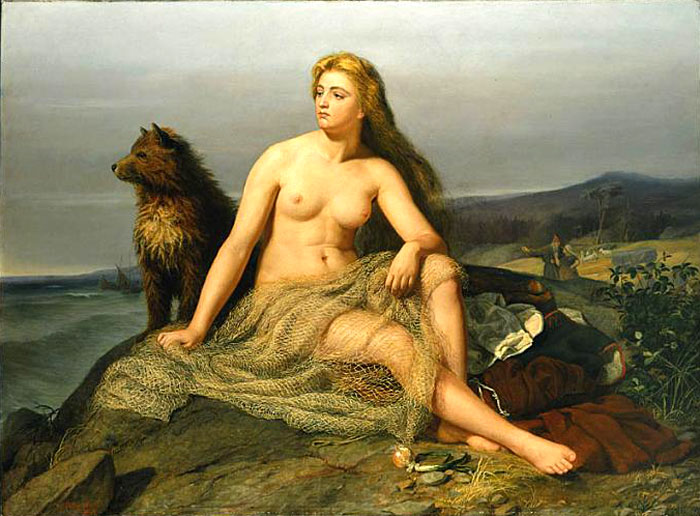
We know a little bit about her and what she does. Her name is a portmanteau of the Swedish words for iron, axe, and scissors (jarn, yxa, and saxa, respectively). In the Poetic Edda (considered one of the oldest texts of Norse culture), we learn that she is one of The Nine Mothers of Heimdall. These Wave-Maidens were responsible for turning the mill which runs the wind and the waves. After Heimdall leaves his mothers to seek his fortune, Jarnsaxa disappears from the Eddas for a while.
She reappears as Thor’s lover. Like before, as a Wave-Maiden, she is a giantess. We learn that she is a Jotun, the same race as Loki. She is also the mother of Thor’s sons, Magni and Modi (respectively named for physical strength, and the desire to fight and kill). It is prophesied that Modi and Magni will eventually inherit Mjölnir, Thor’s hammer, when it is thrown at the end of Ragnarok (the Old Norse apocalypse). We also know from other places in the Eddas that Thor’s official wife is Sif, the goddess of fertility.
So, what can we assume, based on this information? Jarnsaxa has been called Thor’s mistress, lover, even co-wife, but never does she have the role that monogamous marriage confers. Sif is a fertility goddess, associated with summer and the harvest, so she must cover Thor’s aspect as a thunder god and bringer of rain. Therefore Jarnsaxa must cover his warrior aspect. Jarnsaxa’s children embody a warrior’s best qualities, and it’s safe to assume they didn’t only get this from their old man. Shield maidens were an acceptable role in Old Norse culture, a way that women could fight alongside their community, without the official title of Viking. Jarnsaxa’s fighting qualities can be supposed not only from her name, but also her surroundings. Since the Aesir generally looked down on Jotuns, as uncouth and wild, but she snagged Thor, she definitely had to be smoking hot and a lot of fun to be with.
Loki and Thor share many adventures, generally stories in which Loki and/or his Jotun comrades are harmed. Since Loki and Jarnsaxa are both Jotuns, it’s safe to assume they share a bond. Loki will eventually helm the ship that sails against the Aesir in Ragnarok, and Jarnsaxa’s children will directly benefit from Thor’s defeat. Since she’s bearing Thor’s children without The Aesir’s blessing or status, and will benefit from the destruction of the Aesir, all that can come in the middle is a desire for revenge.
Returning to the original proposition, we can take a look at a sentient wind farm, and wonder how it got that way, and what it wants. The world of Old Norse culture lends itself to liminality, a flexibility of boundaries between the past and present, natural and supernatural worlds. This is a place with Northern Lights and white nights, and the states of dreaming and being awake can become blurred. How does Jarnsaxa fit into this scheme?
The Draugr is the Old Norse version of the walking dead. This is just one version of the ways in which souls can transcend the mortal experience. Sometimes, if a dead person is not properly buried, or has unfinished business, their body can live on after them, or, simply, their will. It can inhabit animals, attacking the living until it gets what it wants. In the Eyrbyggja Saga, the will of a dead woman inhabited a seal, attacking humans until its bedclothes were burned, as the departed woman had requested. This story is a precursor of the Irish and Scots folk creature, the Selkie.
More common are the souls of corpses washed up on shore. Having committed no crime, but without a proper funeral, their soul would wander until their body was properly buried. If a living person were to pass the body without trying to help its soul, the ghost would follow and hunt them until it received satisfaction. Stories of supernatural women taking over untended farms at The Winter Solstice, Christmas, and New Year’s Eve (the darkest time of the year in the Northern hemisphere), are popular in Old Norse culture. In some cases, the woman is disguised as a quiet farm girl, who refuses to go to Mass, but instead turns into an Elf Queen and throws a secret party for all of her elvish friends. In other cases, the quiet farm girl reveals a murderous nature, slaughtering livestock and whoever might try to stop her. Christian ritual is often not enough to stop restlessness. In the Eyrbyggja Saga, Thorgunna receives a Christian burial, but returns to tell everyone how cold her resting place is, until they finally fulfill her request to burn her bedclothes. As scholar Kirsti Kanerva says, the ghost is there to shine a light on past wrong, and get things in order, not because of the presence or absence of any particular religion. “The ghosts and wonders manifest the mental and social disequilibrium inherent in these situations…indicating in a concrete way the shadows of the past, deeds that have caused the balance of the minds of men and the order of their society to be shaken by the dead through fear, lunacy, illness, and death.” Like the ghosts in Macbeth and Hamlet, the undead in Old Norse culture are there to push the living to truth and justice.
So, how does a re-animated Jarnsaxa, fueled by revenge, fit into contemporary imagination?
She wants revenge on the Aesir. Like a corporation, this network of gods controls everything, from the seasons and weather to choices about food, shelter and sex. They set rules, and demand loyalty and homage. They can punish or reward, according to their whims. They can use and destroy the natural world however they please, and re-create it in their own image. An ancient giantess, turning a mill which feeds the wind and ways has its mirror opposite in a graceful silvery wind turbine, towering over land and sea to harness the wind’s energy. What comes around, goes around, literally.
Jarnsaxa gives us a means to explore themes of betrayal, sustainability, and revenge through an ancient metaphor. Norse mythology allows us the opportunity to explore time and space in a way which lends itself well to audio drama.
If you’re ready for Jarnsaxa’s saga, you can listen now. She’s available almost anywhere you find podcasts.
Vince is composing and recording Jarnsaxa Rising’s theme music. This process isn’t much to look at, but it sounds amazing.
More proof that I am living in the future: As I type this, pages of sheet music, that Vince has just written and recorded, are coming out of the printer. It’s like flying cars, except the destination comes directly to you.
“You kids have it so goddamn easy. Back in MY day…”
Right now we’re both at the part that doesn’t photograph well. It’s not glamorous, mostly a lot of typing, scribbling, and/or pointing and clicking. But, the script proceeds, the music is good, and in 42 days, we’ll be sitting down to rehearse with Carin and the actors.
Increasingly (finally), our media and fiction centers around powerful women, sometimes in positions of leadership. Characters such as Marvel’s Black Widow, Battlestar Galactica’s Starbuck or President Roslyn, and Orphan Black’s entire cast, take up some hot space in mainstream entertainment. Besides the contemporary settings, we’re also seeing a lot of ancient and/or fantastic women, such as in Game of Thrones or Vikings.
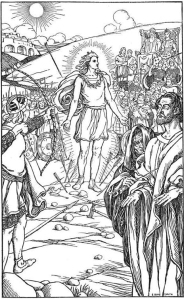
Jennifer Summerfield as Joan of Arc. Photo by Kyle Cassidy.
When our mainstream media concerns itself women with power, in ancient or fantastic settings, we talk about women and power in a non-threatening way. This allows us to experiment via imagination, to examine our own social actions.
How are ancient, science fiction, or fantasy stories non-threatening? By setting a story in a place far removed from contemporary reality, it gives the audience freedom. Shakespeare set his plays on fictitious islands, or far from England in Italy, to:
catch audience attention and pique their interest
examine social morals and manners
allow for experimentation and behavior without it affecting his social or political standing (“it’s only a play that takes place on a pretend island.”)
In the same way, playwright Naomi Wallace used 17th-century London, during the Black Plague, in her play One Flea Spare. This metaphor let her show the underlying social causes (income inequality, prejudice) of the Los Angeles riots.
I use the term “Warrior Queens” to indicate women in positions of leadership, who move themselves and their allies toward a goal, over, around or through obstacles to reach goals. What kinds of Warrior Queens are we seeing here, and how do they operate?
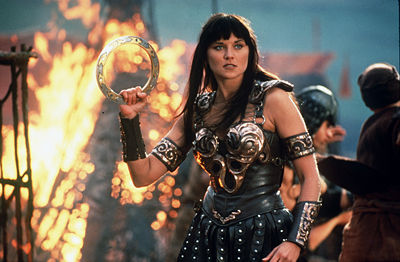
In the late 1990s and early 200s, Xena cornered the television market for “strong women” in an ancient, fictitious world. The television show Xena: Warrior Princess was unique in that it had a female protagonist who “kicked ass” or succeeded in combat situations. She and Gabriele drove the plot and had agency over their own lives.
Game of Thrones has women as political and social decision-makers. This show lets women showcase different methods of leadership and progress. For example, in the first book:
Cersei Lannister uses sexuality as a villainous means of social mobility. Via subterfuge, marriage, and sexual connections, she gets her teenage son on the throne and becomes Queen Regent.
Catelyn Stark gathers support for her clan using her family connections. She captures Tyrion Lannister (believing he conspired to kill her son) and has to negotiate with her sister for his trial. Unlike Cersei Lannister, she uses open debate and trial by combat as a means of social change. To sum up, she calls in favors that have to do with family or status, and uses the power of reputation.
Daenerys Targaryen (Autocorrect and I fought about that one for a while) has a little of each woman’s strategy, and something else. She starts out as a gift to Khal Drogo, a sex slave intended to bring pleasure and breed an heir. She end up as the ultimate Other. Her magic power to command fire-breathing, flying dragons is the ultimate trump card. However, having had the status of a slave, she understands the mentality of those on the bottommost rung of society, and can command armies with only her own voice.
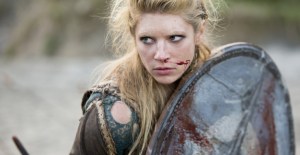
Lagertha, on the show Vikings, is based on a heroine of Old Norse legend. Most of the character’s social mobility happens through marriage. However, she becomes the Earl of Hereby because she stands up to her husband, and to rape. By stabbing him in the eye in front of his allies, she gains their support and political office. The real Lagertha commanded armies, and once sent 120 ships to save her ex-husband in battle, so there’s precedent for this character doing well in a fight.
In these stories, we’re seeing women who:
overcome obstacles to change their lives and that of others
have flaws, but overcome them
use empathy to motivate others
have social mobility and achieve it through their own actions
aren’t afraid of blood.
Why does this matter? If female-driven television shows and movies drive box office and award-show numbers, aren’t we living in a world where we don’t need stories about women being powerful?
If you’ve read this far, you might be rolling your eyes at how obvious the answer to this question is, but I’ll lay it out for you anyway.
Every household knows at least one veteran. Women comprise nearly 15% of the Department of Defense’s Active Duty Force. Topics such as birth control and other health concerns for female soldiers, and women in combat positions (the AP reports that the DoD had plans to allow women to start training as Army Rangers by the end of 2015, and as Navy SEALs by the end of 2016), and sexual abuse and rape in the military are not just theoretical concerns. They’re real things that happen to real people and can be upsetting to consider.
These numbers- 15%, 20%, 19.3%, 5.2%- are ridiculous when you consider that women make up over 50% of the population, earn half of the advanced academic degrees, and nearly 50% of the work force (source.)
Even without considering women’s leadership roles in the military, politics, or business, every woman has her own life. She needs to see herself as a free agent, the leader of her own “army of me” (to paraphrase Bjork). Women need to move toward their own life goals without looking for permission, approval, or that hilarious “wife bonus.” Stories about Warrior Queens give them the confidence to use strategy to take steps toward goals and understand the concept of feminism as self-determination rather than a dirty word.
We’re seeing more women in fiction and media because the demand exists. The Hunger Games set box office records for a reason. We want the metaphor, and the social experiment, so that we can look at our own lives and improve them. Myth, saga, epic, and fable have always been humans’ systems of teaching and learning more about ourselves. Warrior queens metaphorically give us the strength to overcome our own battles.
Jarnsaxa Rising is a podcast about revenge in the future and the past. The story is driven by characters of all genders, and the stakes are world-shattering. To find out how you can be a part of this, visit our Indiegogo page. You can follow our blog with the link above, and you can also follow us on Facebook. Thanks for reading.
 Can you have a story that mentions Norse Mythology without Thor? Nope. Not only is he the God of Thunder, he’s the one who gives Jarnsaxa an axe to grind. Derek Meyer lends his voice to the Scandinavian hero who’s worshipped everywhere from ancient farming rituals to kids’ lunch boxes today.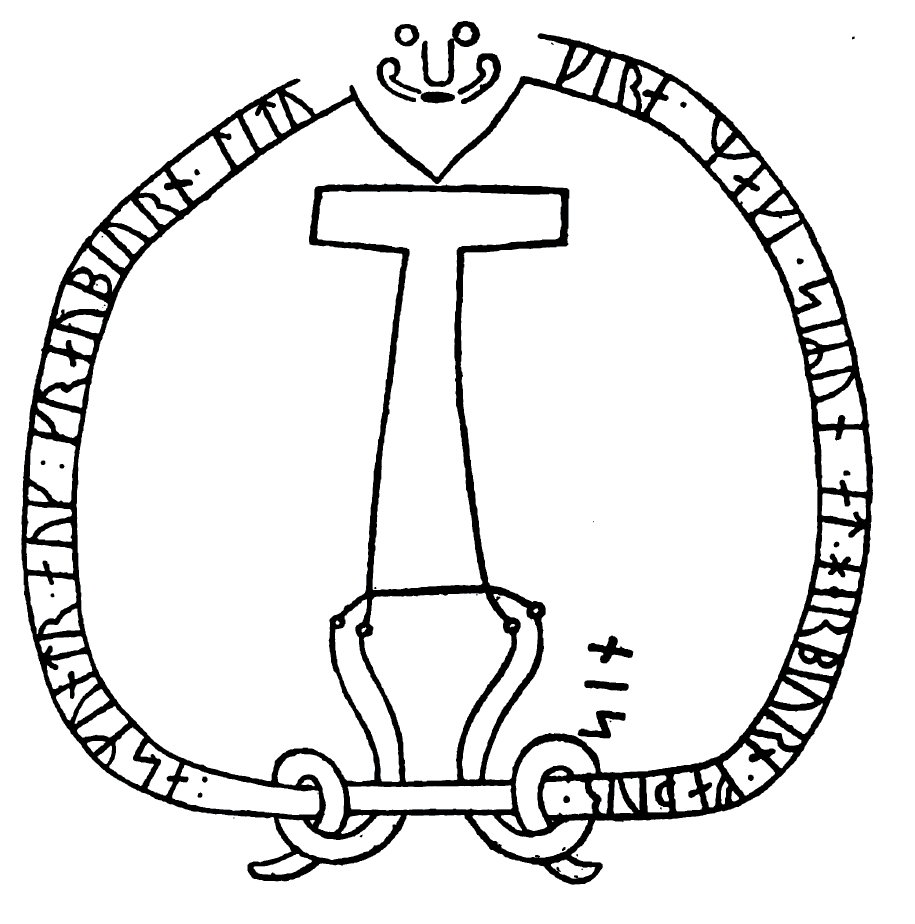
 What made you decide you wanted to do this project?
















 Jarnsaxa Rising: Norse Myth, Energy Crisis, Revenge Drama Podcast.
You must be logged in to post a comment.